


10 Tips for Choosing the Best Aluminium Curtain Track
Choosing the right Aluminium Curtain Track affects more than the way curtains open and close. It influences daily comfort, room appearance, installation safety, and long-term maintenance. A well-selected track should move smoothly, support the curtain’s weight, and suit the window’s shape.
This guide explains ten practical tips for making a confident choice. It considers aluminium quality, track length, load capacity, runner design, ceiling or wall mounting, and available bends. It also examines surface finishes, moisture exposure, cleaning needs, and supplier reliability. These details matter in real homes, hotels, offices, and commercial spaces. A lightweight sheer curtain may need a simple profile, while heavy blackout fabric requires stronger support and carefully spaced brackets.
Small measurements can cause large problems. An extra few centimetres may affect curtain overlap, stacking space, or light control. Even experienced installers can overlook the position of handles, radiators, or deep window frames. That deserves attention. Product photographs can also be misleading, so checking technical drawings and installation instructions is essential. A polished finish does not guarantee smooth performance.
Reliable advice should combine manufacturer specifications with practical experience. Look for clear information about materials, dimensions, testing, warranty coverage, and replacement parts. Ask questions before ordering, especially for oversized windows or curved layouts. The cheapest option may appear attractive. It may not remain economical after difficult installation or early repairs. With careful comparison, the best Aluminium Curtain Track becomes a functional, durable, and visually clean part of the room.
Understand Aluminium Curtain Track Types and Their Uses
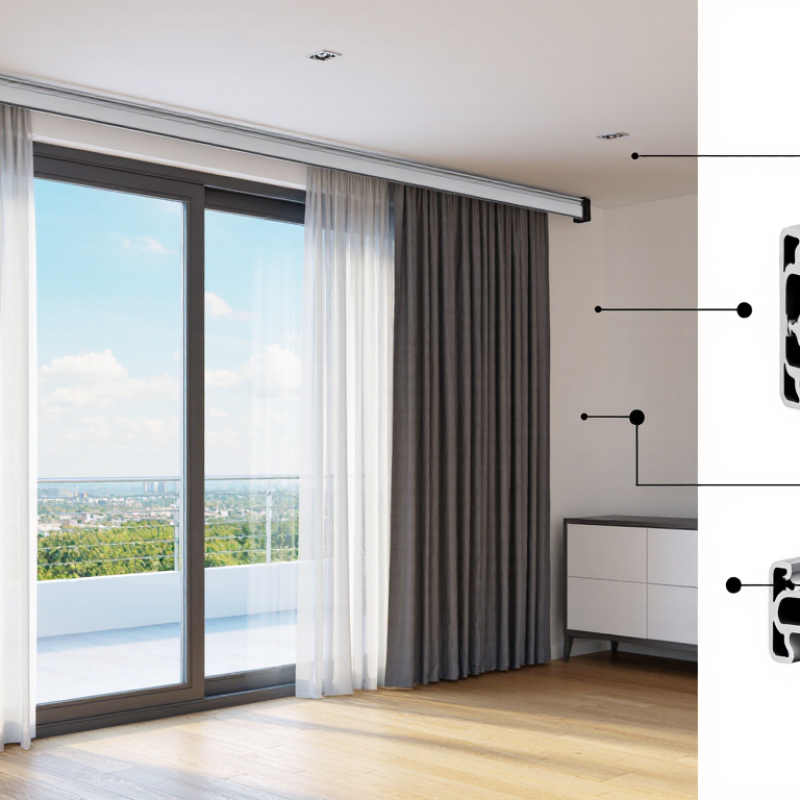
Aluminium curtain tracks come in several forms, and each suits a different window situation. Single tracks support one curtain layer, such as a sheer panel or blackout curtain. Double tracks allow both layers to move independently. This works well in bedrooms, living rooms, and spaces needing flexible light control.
Ceiling-mounted tracks create a clean, hotel-style appearance and suit low windows or full-height curtains. Wall-mounted tracks are easier to access and often fit standard rooms. Bendable aluminium tracks can follow bay windows, curved walls, or unusual corners. They need careful shaping, because an uneven curve may make the gliders catch. Small details matter.
Heavy-duty tracks are designed for lined curtains, thermal fabrics, or large panels. Lightweight tracks work better for sheers and narrow windows. Manual systems are simple and reliable, while motorised tracks help with tall, wide, or hard-to-reach windows. In humid rooms, check the aluminium finish and fasteners for corrosion resistance. Measure the curtain weight, track length, and fixing points before buying. I have seen attractive tracks fail because the wall anchors were too weak. That mistake is easy to overlook. Allowing extra support near joints and ends usually improves movement. Still, every wall material behaves differently, so installation advice should match the actual surface.
10 Tips for Choosing the Best Aluminium Curtain Track - Understand Aluminium Curtain Track Types and Their Uses
| No. | Selection Tip | Aluminium Track Type | Typical Use | Common Profile or Size Guidance | Recommended Curtain Weight | Important Checks |
|---|---|---|---|---|---|---|
| 1 | Match the track to the curtain weight. | Standard single-channel track | Light and medium curtains in bedrooms, studies, and living rooms | Usually a slim 20–30 mm wide profile; confirm the supplier’s load rating | Light to medium fabrics, commonly up to about 5 kg per track; rating varies by design and support spacing | Check the combined fabric, lining, heading tape, and accessories weight |
| 2 | Choose a heavy-duty profile for lined or blackout curtains. | Heavy-duty aluminium channel track | Blackout curtains, thermal curtains, hotel rooms, and large windows | Often approximately 25–40 mm wide with a deeper or reinforced channel | Medium to heavy fabrics; use the tested load rating rather than profile size alone | Provide closer brackets for long runs and heavy curtains to reduce deflection |
| 3 | Select a bendable track for curved windows. | Flexible or bendable aluminium track | Bay windows, bow windows, curved walls, and room dividers | Commonly supplied in 5–6 m lengths and shaped on site; minimum bend radius depends on the profile | Light to medium curtains are generally easier to operate on tight curves | Confirm inside or outside bend capability, radius, joins, and carrier movement before ordering |
| 4 | Use a ceiling track when wall space is limited. | Ceiling-mounted aluminium track | Full-height curtains, sliding doors, minimalist interiors, and concealed installations | Slim profiles are often about 10–20 mm deep; recessed systems require a suitable ceiling pocket | Choose according to the manufacturer’s ceiling-fixing load rating | Check ceiling construction, anchors, service pipes, and the required curtain drop |
| 5 | Choose a wall-mounted track when the ceiling is unsuitable. | Wall-mounted aluminium track with brackets | Windows with cornices, suspended ceilings, or inaccessible ceiling voids | Bracket projection commonly ranges from about 50–150 mm, depending on clearance needs | Load depends on bracket spacing, wall strength, and the track profile | Allow clearance for window handles, radiators, blinds, and curtain fullness |
| 6 | Use a double track for layered window treatment. | Double-channel aluminium track | Sheer plus blackout curtains, privacy systems, and hotel-style installations | Overall width is commonly about 50–80 mm, depending on channel spacing | Calculate the weight of each curtain layer separately | Check front-to-back clearance so both layers can open without rubbing |
| 7 | Choose a hand-drawn or cord-operated system according to reach. | Manual aluminium track | Standard windows that are easy to reach and operate | Available as single or double channels with standard carriers and end stops | Suitable when the curtain can be opened without excessive pulling force | Choose smooth carriers and a pull wand for tall or delicate curtains |
| 8 | Consider motorisation for large or hard-to-reach windows. | Motorised aluminium curtain track | High windows, wide glass doors, home automation, and accessibility applications | Straight or curved profiles; track length and motor capacity must be specified together | Select a motor based on curtain weight, length, fabric fullness, and movement direction | Check power supply, manual override, noise level, controls, and maintenance access |
| 9 | Measure the track length and overlap correctly. | Straight or made-to-measure aluminium track | Windows, patio doors, room dividers, and wall-to-wall curtains | For wall coverage, extend the track beyond the opening when space allows; a common allowance is 150–300 mm per side | Curtain fullness commonly ranges from 1.5× to 2.5× the track width, depending on the heading style | Measure at least three points for width and verify the finished curtain height |
| 10 | Check finish, corrosion resistance, and maintenance needs. | Anodised, powder-coated, or standard-finish aluminium track | Dry interiors, humid rooms, coastal areas, and commercial spaces | Common finishes include white, silver, and matte colours; anodised surfaces are often selected for durability | Finish does not determine load capacity; use the structural rating for weight selection | Confirm corrosion protection, cleaning instructions, replacement carriers, and spare-part availability |
Note: Dimensions, load capacities, bend radii, and bracket spacing vary by aluminium profile, carrier design, fixing method, and installation conditions. Always verify the technical data for the selected track system before installation.
Related Posts
-
What is Aluminium Surface and its Benefits for Buyers?
-
What is Aluminum Alloy Door Factory and Its Benefits?
-

Top Benefits of Aluminium Alloy Corrosion Resistance for Industry Use?
-
How to Choose the Right Aluminium Applications?
-
Top Benefits of Aluminium Extrusion Heat Sink for Efficient Cooling Systems?
-

What is the Average Aluminium Profile Price List for Buyers?


